
FLO: A Hidden Detail
Understanding Flat Line Oscillation and why shaft orientation matters
When golfers think about custom-fitted golf clubs, they typically focus on clubhead design, shaft flex, shaft weight, length, lie angle, and grip size. These are all important factors in building clubs that fit a golfer.
But there is another detail that often goes unnoticed: the rotational orientation of the shaft when the club is assembled.
A golf shaft may look perfectly round and uniform on the outside, but that doesn't necessarily mean it bends identically in every direction. Flat Line Oscillation, commonly called FLO, is a technique used to identify a shaft's preferred bending orientation so that it can be positioned deliberately during club assembly. Studies have shown that optimizing shaft orientation can result in small gains in distance and, more importantly, reduced shot dispersion.
At Black Swan Ironworks, we believe that quality club building means paying attention not only to the specifications a golfer can see, but also to the details that can influence how a club behaves.
What is flat line oscillation (FLO)?
Imagine holding a flexible ruler at one end, bending the free end to one side, and releasing it. The ruler springs back and oscillates as it returns toward its resting position. A golf shaft behaves in a similar way.
When a shaft is clamped at the grip end, deflected, and released, Its tip begins to oscillate. Depending on the shaft's construction and rotational orientation, the tip may move along a relatively straight path or follow a more varied pattern.
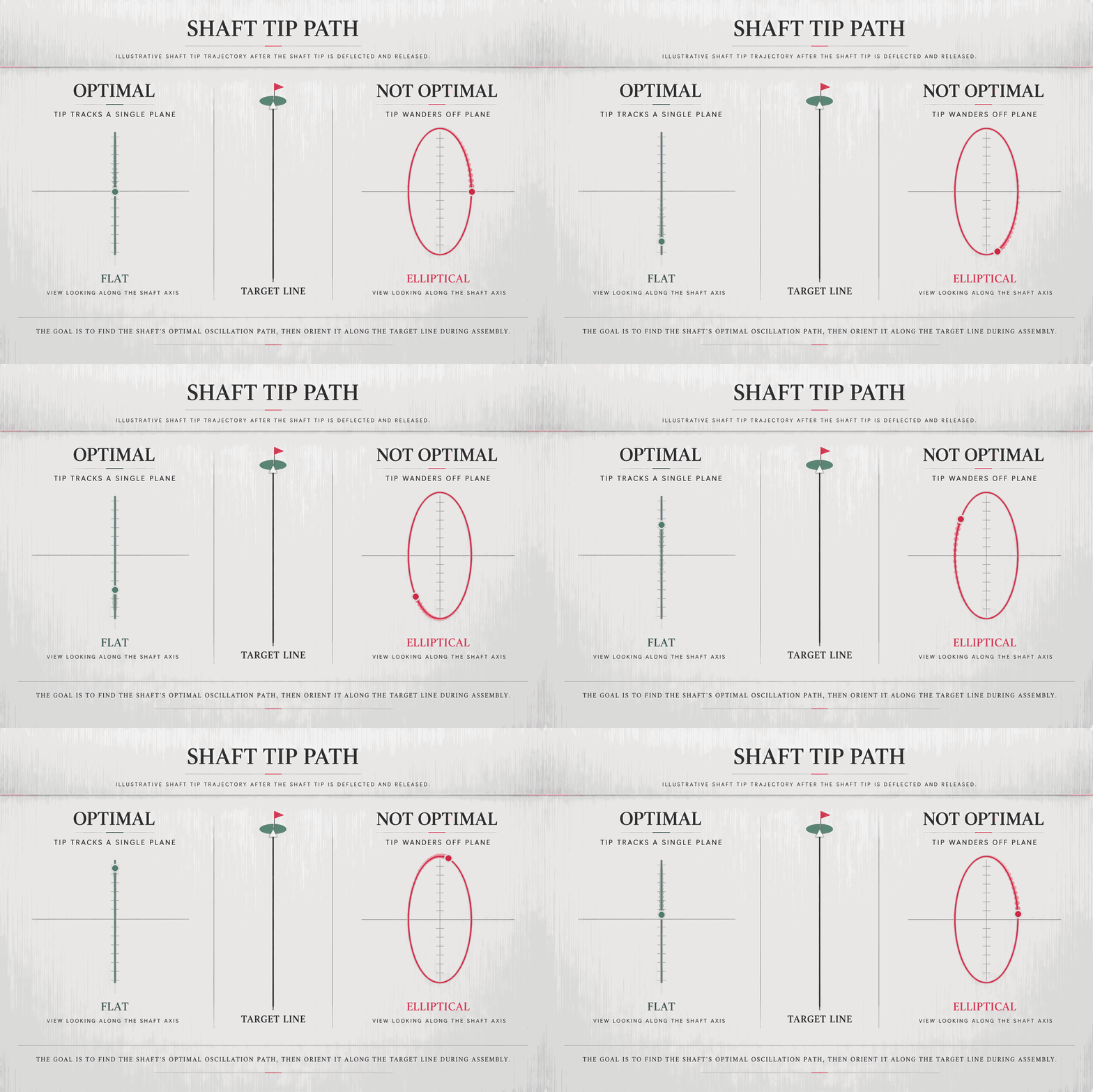
FLO is the process of rotating the shaft and observing its oscillation until a stable, relatively flat path is identified. This preferred oscillation plane gives the club builder a reference for orienting the shaft when attaching the clubhead.
Why doesn't a shaft bend exactly the same in every direction?
Although a golf shaft may appear perfectly symmetrical, its internal structure is not necessarily uniform in every direction. Two shafts with identical model names, nominal flexes, and weights will not exhibit identical directional bending characteristics.
Steel shafts and graphite composite shafts are manufactured differently, and both can exhibit variations in their directional bending characteristics. These variations can arise from manufacturing tolerances, material distribution, wall thickness, and other factors. Graphite shafts are particularly susceptible because they are constructed in multiple layers. The consistency, orientation, and arrangement of those layers can influence how the shaft responds to bending in different directions.
Think of it this way: a shaft may have slightly different bending characteristics depending on which direction it is loaded. Its outside appearance alone won't necessarily reveal those differences. FLO provides a practical way to observe this behavior rather than assuming that every rotational orientation is equivalent.
Why not just install the shaft logo-up?
Installing a shaft logo-up is a familiar convention. It provides a consistent visual presentation and makes the graphics easy to read. But two shafts installed logo-up may have significantly different directional characteristics due to manufacturing variation. The important distinction is that logo-up assembly selects an orientation based on appearance, while FLO selects an orientation based on the shaft's observed oscillation behavior.
At Black Swan Ironworks, we believe good club building involves more than assembling components to their nominal specifications. Every design and assembly decision should have a reason. Shaft orientation is no exception.
FLO provides a practical means of evaluating how an individual shaft oscillates, establishing a repeatable reference, and using that reference during assembly. It is one more way to bring measurement, consistency, and attention to detail into the club-building process.
Our philosophy is simple: if a characteristic can be measured and controlled, it deserves consideration when building a better golf club.